Observation
Your 35-day scaling floor applies
Stock covers 17 days. Your rule asks for at least 35 days of cover before advertising is scaled.
Observation · No ad-budget recommendation
Private beta · Amazon sellers first
The merchant-specific decision and governance layer for Amazon sellers. It weighs your stock, cash, margins and rules before anything reaches you.
Same campaign for both: Campaign X, strong return, ROAS 4.0.
Illustrative sample businesses. Not customer data.
17 days of cover, below its 35-day floor6 days of cover, 5-day lead time
Observation
Stock covers 17 days. Your rule asks for at least 35 days of cover before advertising is scaled.
Observation · No ad-budget recommendation
Recommendation
Stock covers 6 days and restocking takes 5. Sized from today’s stock to a 30-day cover target; it fits the cash above your reserve.
Recommendation ready
Seller
Awaiting your decision
Cash above reserve $5,000 · Objective Cash preservation · Scaling floor 35 days · Lead time 45 days · Margin after ads 22%, minimum 18%, same for both
Cash above reserve $70,000 · Objective Growth · Scaling floor None configured · Lead time 5 days · Margin after ads 22%, minimum 18%, same for both

Recommendation
Stock covers 6 days and restocking takes 5. Sized from today’s stock to a 30-day cover target; it fits the cash above your reserve.
Recommendation ready
Seller
Awaiting your decision
Decision stories
ShOpti weighs each one against the whole business.
Three standalone illustrative situations. Not customer data.
Stock calls for a reorder. Your return rule stops it.
SKU A
Candidate reorder · SKU A
Stock today
Previous period4.0%
This period10.8%
7 above your rule
Your rule · 8%
Reorder SKU A
Blocked by your business rules
Cover evidence 2 and lead time evidence 3 call for a reorder. The return rate evidence 1 is above your 8% rule.
Your rule · Return rate above 8% blocks reorders
The best-looking campaign isn’t always the best investment.
Campaign One reports ROAS 4.0 on $1,000 of ad spend, $4,000 of attributed revenue, with 18% margin before ads: minus $280 after ad spend. Campaign Two reports ROAS 3.0 on $1,000, $3,000 of attributed revenue, with 45% margin before ads: plus $350 after ad spend.
Campaign One: $300 of its $1,000 went to search terms with no orders
Recommendation
ROAS counts sales per ad dollar, not what those sales leave after costs. Campaign One’s sales do not cover its spend, and $300 of it went to search terms with no orders evidence 4. Campaign Two adds $350 after ad spend.
Recommendation ready
Seller
Awaiting your decision
Without a unit cost, there is no profit to judge.
SKU E
No advertising or profit recommendation is made for SKU E until its unit cost is added.
Withheld
Unit cost · Missing
Data required
No decision until the unit cost is added.
Recommendation conflict
Illustrative sample business. Not customer data.
Campaign K
An ad tool
ROAS 3.5: scale it.
Profit
Loses $360 after ads.
Cash
Inventory
Order SKU T and SKU P.
Cash
$8,000 above your reserve.

SKU T is prioritized first and leaves $800. SKU P waits outside.
What fits the whole business?
How ShOpti decides
Every DecisionPackage you receive has passed deterministic governance. Challenger and evidence assurance review every material proposed decision, twice when it commits cash.
Intelligence can come from anywhere. Authority does not. ShOpti’s architecture can take outside intelligence through these same checks where it is integrated. In the private beta, no outside tool or agent is connected.
ShOpti
Your inputs, reconciled into exact facts every later step relies on.
Computed register
Computed, not generated.
Four specialists each investigate one domain of the same business.
Finding 1: Costs and stock confirmed for every item
Finding 2: Campaign K loses $360 after ads
Finding 3: $420 went to search terms with no orders
Finding 4: SKU T and SKU P each have a week or less of cover
Raises the strongest grounded objection to the proposed decision.
SKU P is as short of stock as SKU T. Funding SKU T first leaves SKU P waiting.
Recorded for governance.
Checks that the claims are actually supported by evidence.
Evidence assurance
Applies your rules and constraints the same way, every time.
Rules, not an agent
Cash reserve · $35,000 kept: SKU T uses $7,200 of the $8,000 above it, leaving $800, not enough for SKU P.
Outcomes
Reorder SKU P
Not selected · Deferred
Trade-off: insufficient cash capacity
ShOpti considered this but did not choose it.
Ranked across the whole business, not within one domain.
In priority order
Recommendation
Priority 01
SKU T covers 7 days and restocking takes 5, with nothing on order. An order now lands before stock runs out.
Recommendation ready
Seller
Awaiting your decision
Priority 02
ShOpti does not execute actions in your Amazon account. You decide what happens next.
Context, not a governance outcome
Check SKU M’s fee change
Investigation · A review to make
Illustrative sample business. Not customer data.
Decision Queue
The reasoning can be complex. What reaches you should not be.
Open a decision to see its full DecisionPackage.
Priority 01 DecisionPackage
Recommendation ready
What
Why now
Key evidence
Priority
Priority 01. Ranks above Campaign K: the stock gap is the more material problem.
Status
Recommendation readyPassed governance.
Cash account
Trade-off The $800 left is not enough for SKU P’s reorder.
Details
Risk
Sized from today’s stock. Sales during the 5-day lead time leave about 26 days of cover when it lands, short of the 30-day target, assuming constant demand and timely delivery.
Dependency
Shares cash with: Reorder SKU P · Not selected
Policy
Cash reserve: the order fits above your $35,000 reserve. Applied by deterministic governance.
Seller Awaiting your decision
ShOpti does not execute actions in your Amazon account. You decide what happens next.
Priority 02 DecisionPackage
Recommendation ready
What
Why now
Key evidence
Priority
Priority 02. Ranks after SKU T’s reorder.
Status
Recommendation readyPassed governance.
Your limit
Trade-off Sales from those search terms stop; they produced no orders in this period.
Details
Narrowing removes this waste; it may not make the campaign profitable on its own.
Seller Awaiting your decision
ShOpti does not execute actions in your Amazon account. You decide what happens next.
Also considered in this analysis
Reorder SKU P
Trade-off: insufficient cash capacity
ShOpti considered this but did not choose it.
Not selected · Deferred
Illustrative sample business. Not customer data.
Decision lifecycle
With your new reports and business context, ShOpti analyzes the business again and reevaluates its decisions.
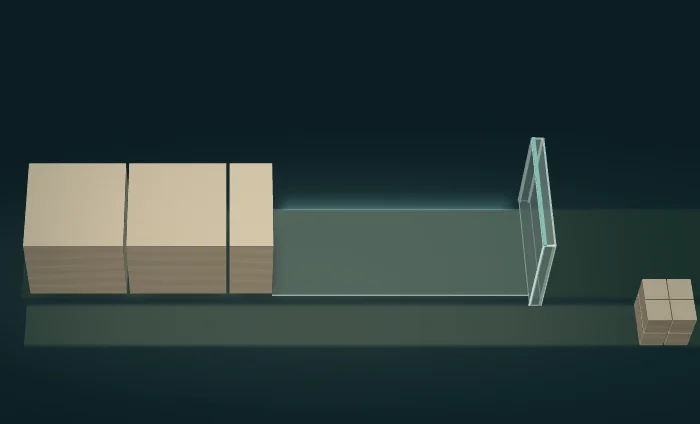
Drawing of the earlier analysis: $8,000 of cash above your $35,000 reserve, one stone per $1,000. SKU T's reorder, $7,200, covers all but $800 of it. SKU P's reorder lies set aside on the floor, outside the cash above your reserve: not selected, deferred.
Earlier decision
Recommendation ready
Reorder SKU P
Not selected · Deferred
Trade-off: insufficient cash capacity
ShOpti considered this but did not choose it.
Drawing of the next analysis: $12,000 of cash above your $35,000 reserve, one stone per $1,000: 4 stones, $4,000, more than in the earlier analysis. SKU P's reorder, $2,520, now rests on the added stone as a Recommendation ready decision. SKU T is not shown in this analysis.
Recommendation
Cover is down to 5 days with a 4-day lead time, and $2,520 now fits the $12,000 above your reserve.
Recommendation ready
Seller
Awaiting your decision
Illustrative sample business, followed to a later analysis. Not customer data.
ShOpti does not execute actions in your Amazon account. You decide what happens next.
Private beta
Every example on this page is illustrative. The private beta is free for a limited number of selected Amazon sellers.
Eight questions. We read every application.
You’ll work with the people who built it.


Questions
Amazon sellers whose advertising, inventory and profit decisions already affect each other, and who want help deciding rather than someone running their account. The application asks for rough bands so we know who to speak to first. None of them is a cut-off.
Decisions where profit, advertising, inventory and cash pull against each other: which ad spend to narrow, which restock to order and whether it fits your cash, and when one of your own rules holds an action back. Decisions that pass governance reach you as DecisionPackages with what to do, why now, the evidence, the trade-offs and their priority across your business.
Amazon Seller Central reports that you upload, plus the context only you know: costs, cash and reserve, margin thresholds, replenishment times and your own limits. Accurate costs matter most. Where required evidence is missing, ShOpti holds a decision back rather than guess.
No. ShOpti does not execute actions in your Amazon account. You decide what happens next. Accepting a DecisionPackage does not carry it out either. In the private beta, ShOpti doesn’t connect to your Amazon account at all; it works from the reports you upload.
Yes. ShOpti doesn’t replace them. In the private beta it works from the Seller Central reports you upload and the business context you provide, not from your other tools. Its job is to show which action fits your whole business.
Yes, for the sellers selected to take part. We plan to start with a small group of about 5 to 10 Amazon sellers over about 8 weeks. Applying doesn’t guarantee a place or a start date.
We read every application and reply by email if there is a fit. Applying is not acceptance, creates no account and gives ShOpti no access to your Amazon account or data.
ShOpti shows which decisions fit your whole business, why they fit, and what deserves your attention next. The decision stays yours.